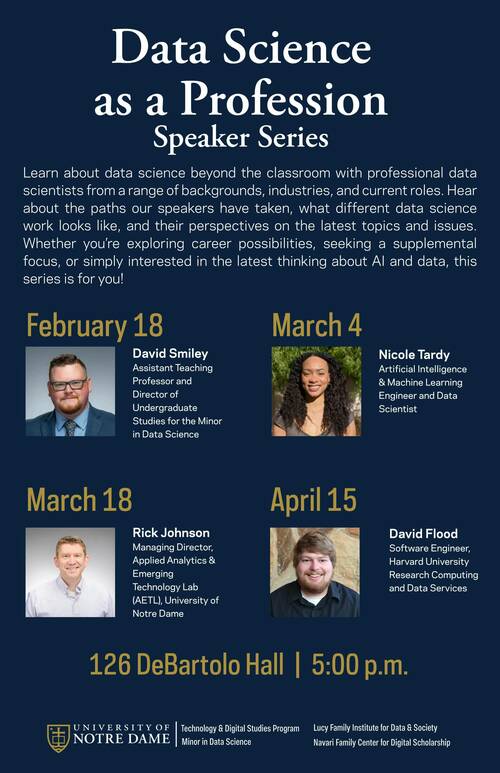
Learn about data science beyond the classroom with professional data scientists from a range of backgrounds, industries, and current roles. Hear about the paths our speakers have taken, what different data science work looks like, and their perspectives on the latest topics and issues. Whether you’re exploring career possibilities, seeking a supplemental focus, or simply interested in the latest thinking about AI and data, this series is for you!
Description:
In the popular imagination, "Data Science" often evokes images of financial modeling or big tech algorithms. But there is a critical need for data professionals within the humanities and the academy at large. This talk explores the emerging profession of the Research Software Engineer (RSE)—a role that sits at the intersection of domain expertise and advanced technical engineering.
David Flood will share his unconventional journey from a PhD in New Testament textual criticism to working as a Software Engineer at Harvard University. He will discuss how the specific challenges of his research—analyzing ancient manuscripts and complex textual traditions—forced him to become a tool-builder. The lecture will define what it means to be an RSE and how his humanities experience has proven to be a valuable asset.
Bio:
David A. Flood is a Software Engineer for Arts & Humanities Research Computing at Harvard University. He specializes in Digital Humanities, working with faculty to architect virtual research environments and data visualization tools that bring traditional scholarship into the digital age.
David’s path to engineering was forged through necessity during his doctoral studies. He holds a PhD in New Testament and Early Christianity from the University of Edinburgh (2024), where his research on the manuscripts of John of Damascus required him to develop novel software for textual criticism. This "scholar-first" approach to technology led to the creation of open-source tools like Apatosaurus and Criticus. Today, he advocates for the professionalization of Research Software Engineering, helping to build the technical infrastructure that powers modern humanities research.